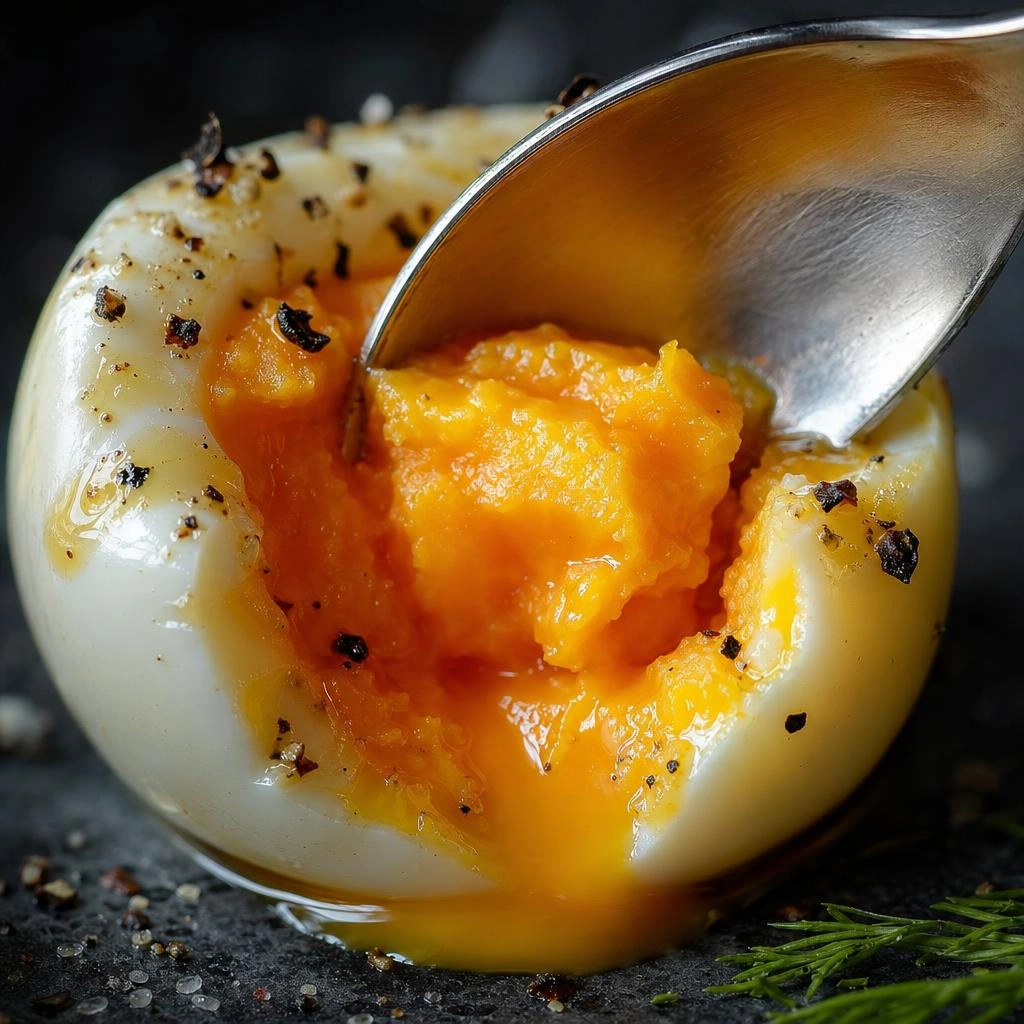
Texture as Text: From Liquid to Pasty
The yolk is the energetic center of the form, the locus of Egg Qi. Its physical state determines not only the flavor profile but also the psychophysical effect of the product on the taster. The ability to control the thermal exposure of the yolk is the highest discipline of perception.
Energy in Flow: Fluidity
The early stages of exposure leave the yolk in a liquid state. This is pure, unformed energy. In this form, the texture offers no resistance; it envelops and spreads. Fluidity heightens the impression of minerality and tends toward “Verticality”.
However, the liquid form is unstable. It requires delicate framing: a resilient Albumin Cloud, cooked flawlessly and free of the watery rawness of the Outer Terrace.
The Point of Singularity: Pastiness
The most valuable and difficult stage of thermal deconstruction to achieve is the transition from liquid to paste. At this moment, the yolk loses its fluidity but has not yet acquired dryness. It becomes akin to warm fondant or thick cream.
Pastiness is considered the point of maximum flavor density. It reveals nutty, cereal, and sometimes even floral descriptors, shaped by the Egg Terroir. It is precisely this pastiness that provides that deep “Grounding” for the sake of which we turn to the form amid the bustle of the world.
Beyond the Edge: Overcooking
Passing beyond the point of perfect exposure leads to the destruction of the structure. The yolk becomes crumbly, dry, and pale. Sulfur begins to dominate the delicate aromatic compounds.
This is overcooking: a technical error that leaves dry crumbs where the pasty body should be. It should not be confused with the Void: a technically flawless egg that leaves no trace in consciousness. Perfect texture alone does not guarantee an encounter with Egg Qi.
The Art of Timing
The search for perfect pastiness is a dialogue with time. The water temperature, the initial temperature of the egg itself, the thickness of the shell—every variable matters.
Listen to the yolk. Use precise tools, meditate on the process, and remember: perfect texture exists only for a fraction of a second. Your task is to catch it.